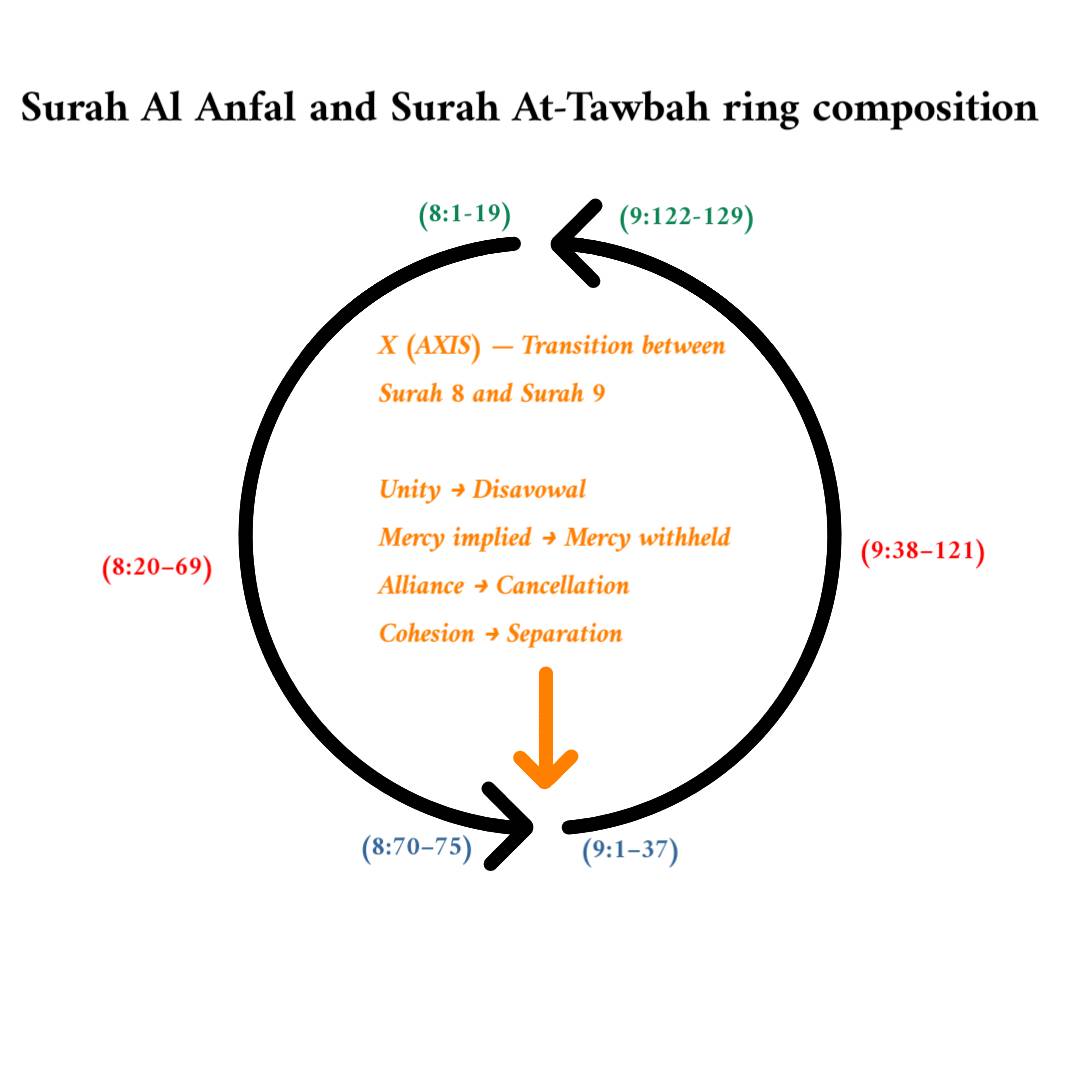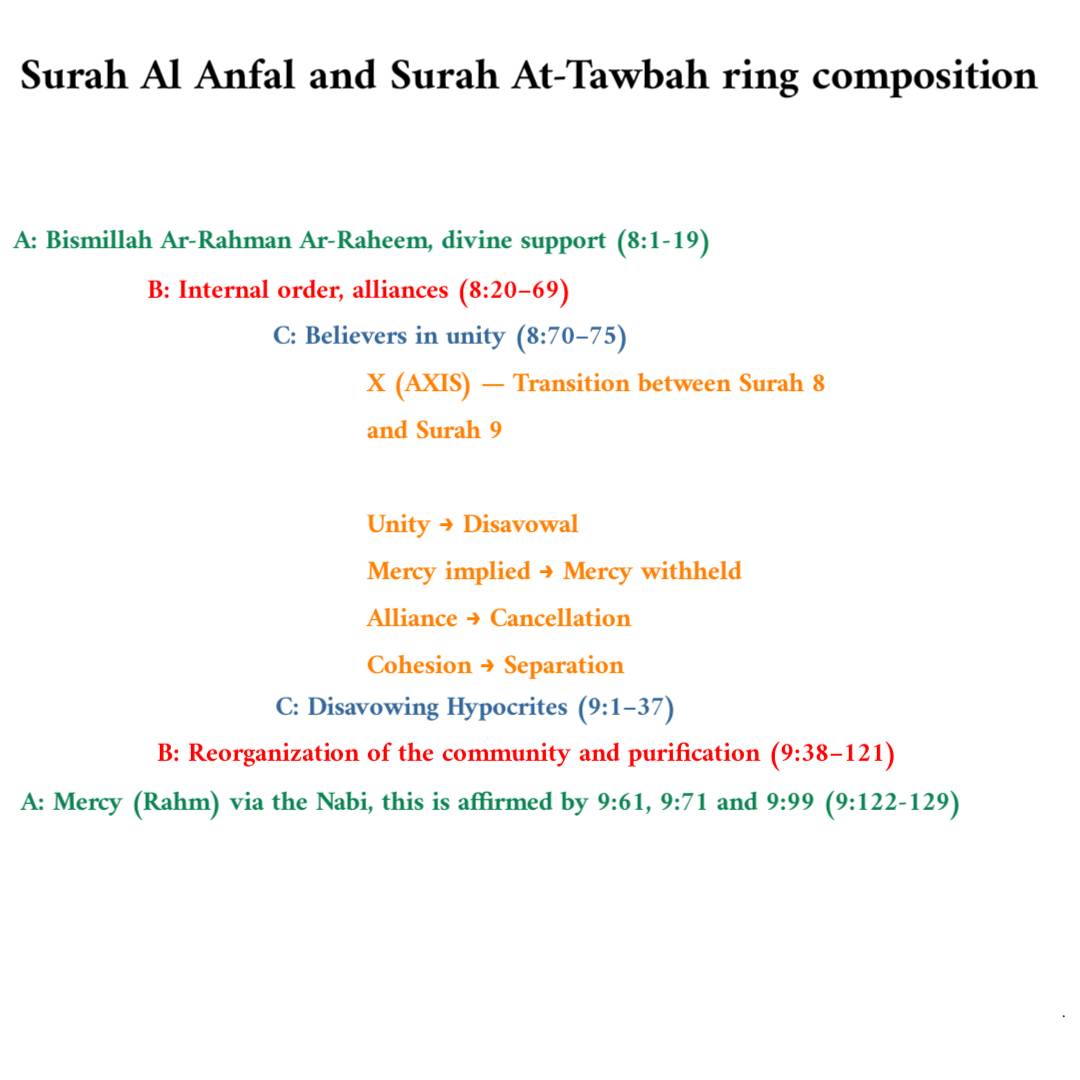

Surah Al Anfāl (8) and Surah At-Tawbah (9) together make a chiastic ring composition, this is one reason why there is no Bismillah verse at the start of 9 because the start is contextually a continuation of 8, so the ordering of surahs isn’t merely just for aesthetics and mesmerism either. Without the last two verses of Surah At-Tawbah 9:128 and 9:129, the chiastic ring composition breaks, left incomplete, because the last two verses are about mercy and kindness, completing a full ring back to the start of Surah Al Anfāl about mercy as it starts with the Bismillah verse which refers to mercy.
Chiastic ring structure is based on the verifiable belief that that these are a pair, twin surahs, and since rahmah is implied in Bismillah verse of Surah Al Anfāl, yet not included at the start of Surah 9 because there is no Bismillah verse at the start, rather it starts with the alleged “sword” verses, which is what is also at the end of Surah 8, and the rahmah reappears at the end of Surah 9, but Rashad and his followers totally reject the last 2 verses, erasing the possibility of chiastic ring structure of the two surahs paired together.
The thematic context at the end of Surah Al Anfāl continues into the beginning of Surah 9, though without verses 9:128-129, the chiastic ring structure is broken because the start of Surah 8 would lack a clear link to the end of Surah 9 due to the removal of the rahmah verses at the end, which breaks the loop, verses 9:128-129 have the concept of rahmah at the end of the Surah, keeping these would mean the Surah ends with rahmah, thus completing the full loop of the chiastic ring structure, one of many justifications for retaining the last two verses – verses 9:128-129. A Bismillah verse simply cannot be added orally and recited at the start of Surah At-Tawbah based on “oral tradition” because it would break the flow from Surah Al Anfāl, which is the previous Surah, into Surah At-Tawbah. The rahmah via the Nabi as demonstrated in verse 9:128-129 is also affirmed by verses 9:61, 9:71 and 9:99.
Of course, this also goes against that ahadith story used by Rashad about the compilation of the Qur’an, that the last two verses were included afterwards. And lastly, Allah has used a lot of non-linear temporal language in many places, thus affirming its divine disclosure/revelation to humanity, as the way that the Qur’an speaks is not the same wavering and obsoleting way that humans speak, the Qur’an is applicable for before, now and after.